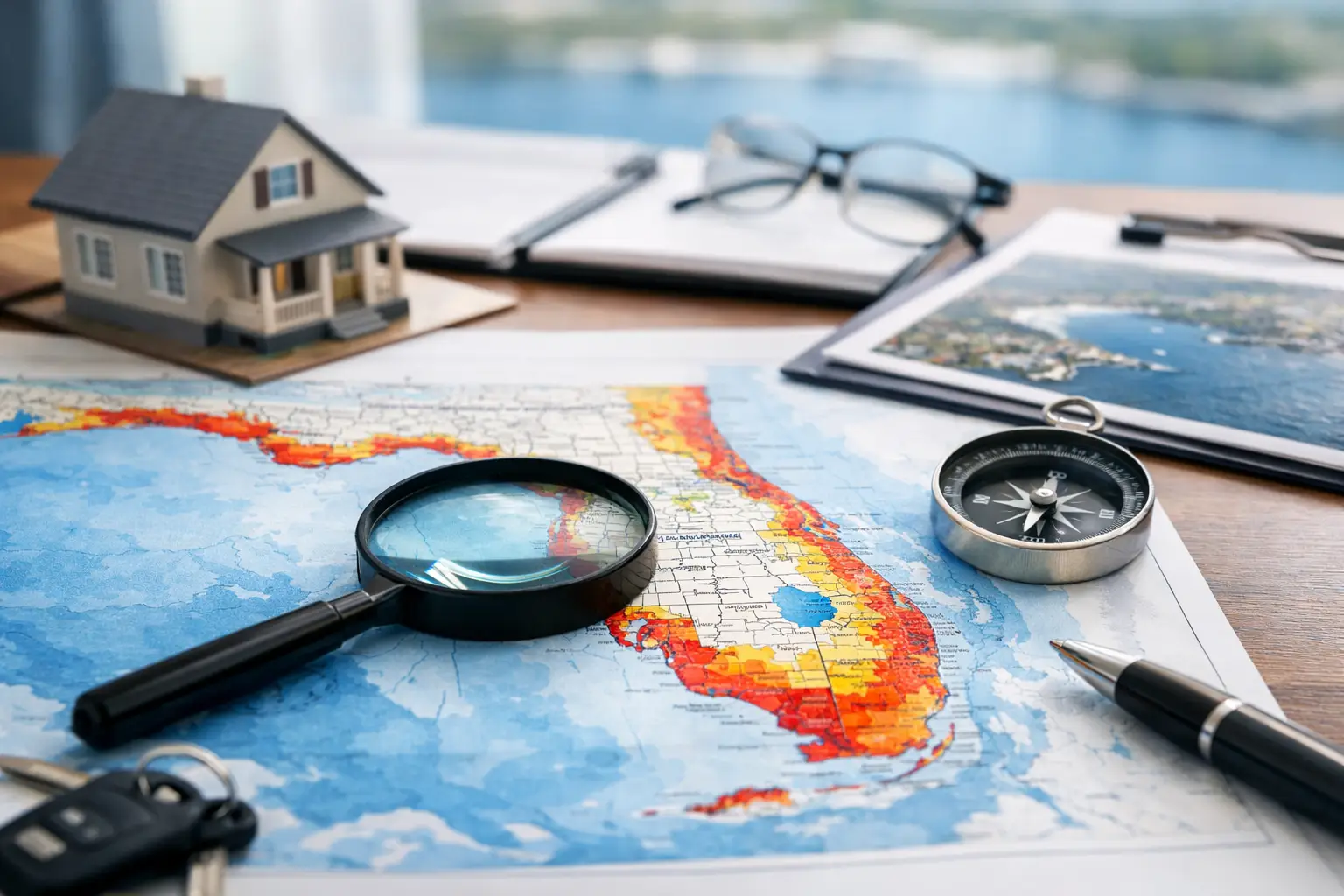
A home can check every box – the right school zone, a shorter commute, a backyard big enough for weekends outside – and still raise one big question when you look at the map: is it in a flood zone? That is where Florida flood zone maps explained really matters, because the answer can affect insurance costs, financing, resale value, and your comfort level with the property.
In Florida, flood maps are not just a technical detail for engineers or insurance agents. They shape real buying decisions every day. If you are purchasing in coastal areas, near canals, around inland lakes, or even in neighborhoods that do not look especially flood-prone, understanding the map can save you from expensive surprises.
What Florida flood zone maps actually show
Flood zone maps are created to estimate the likelihood of flooding in a given area. The most commonly referenced maps come from FEMA, and they divide land into zones based on flood risk. These zones are used by lenders, insurers, municipalities, buyers, and sellers.
The first thing to know is that a flood zone does not tell you whether a home has flooded before. It tells you how the property is classified based on modeled risk, elevation data, rainfall patterns, storm surge exposure, and other factors. A house can sit in a lower-risk zone and still experience flooding. A house in a higher-risk zone may never have had a flood claim. The map is a risk tool, not a guarantee.
That distinction matters in Florida, where hurricanes, tropical systems, heavy rain events, drainage issues, and rising water can all play a role. A map gives you a starting point, but not the whole story.
Florida flood zone maps explained by zone type
Most buyers will run into a few core flood zone labels.
Zone X usually means a lower flood risk. Many homes in Zone X are outside the Special Flood Hazard Area, which is the area where federally backed lenders typically require flood insurance. That said, lower risk does not mean no risk. Plenty of flood claims happen outside high-risk zones.
Zone AE is one of the most common higher-risk designations. It means the property is in a Special Flood Hazard Area and usually has a defined base flood elevation. If you are financing a home in AE with a federally regulated lender, flood insurance is often required.
Zone VE is generally associated with coastal areas that face wave action and storm surge risk. These zones tend to come with stricter building standards and can carry higher insurance costs.
Zone A is also considered high risk, but it may not always include a determined base flood elevation. That can make underwriting and property evaluation a little more complicated.
You may also see shaded Zone X, which represents moderate risk. It sits somewhere between the highest-risk and lowest-risk categories, and insurance may still be worth serious consideration even when it is not mandatory.
Why the zone matters beyond insurance
Most people first ask about flood zones because of insurance, and that makes sense. Monthly housing costs can change quickly when flood insurance enters the picture. But the map affects more than that.
A flood zone can influence lender requirements, inspection priorities, renovation costs, and buyer demand when it is time to sell. If a property needs elevation certificates, flood vents, or added mitigation features, those costs can become part of the ownership picture. Some buyers are comfortable with that trade-off if the home is in a strong location or offers better pricing. Others want to avoid the uncertainty entirely.
For investors, the calculation can be even more specific. A property with strong rental potential may still need to pencil out after insurance premiums, vacancy risk tied to storms, and maintenance planning. A lower purchase price in a higher-risk zone is not automatically a better deal.
How flood insurance works with Florida flood zone maps
Here is the practical reality: if the home is in a high-risk zone and you are using certain types of financing, your lender may require flood insurance before closing. If the home is in a lower-risk zone, insurance may be optional from a lending standpoint, but that does not always mean it is wise to skip it.
Insurance pricing depends on more than the zone label. Carriers may look at elevation, construction type, replacement cost, foundation design, prior claims, and the home’s distance from water. Two houses on the same street can have very different premiums.
That is why buyers should avoid assuming the map alone tells them the full cost. The smarter move is to pair the flood zone review with actual insurance quotes early in the process. Waiting until the final stretch of a transaction can create budget stress or force a last-minute decision.
What buyers should check before making an offer
If you are serious about a property, do not stop at the colored map overlay. Ask deeper questions.
Start with whether the current owner carries flood insurance and, if so, roughly what the premium looks like. Then ask whether the home has ever experienced flooding, water intrusion, drainage problems, or storm-related damage. Seller disclosures help, but they are only one piece of the picture.
It is also smart to ask for the elevation certificate if one exists. That document can help clarify how the home sits relative to expected flood levels. In some cases, a favorable elevation can help with insurance costs even in a higher-risk zone.
You should also look at the lot itself. Is the property on a canal, near a retention pond, at the end of a low-lying street, or in an area known for poor drainage after heavy rain? Local experience matters here. In parts of South Florida, two neighborhoods that seem similar on paper can behave very differently during storm season.
What sellers need to understand
For sellers, flood zones are often a concern because they worry the designation will scare buyers away. Sometimes it does narrow the buyer pool, but clarity helps more than avoidance.
A well-prepared seller can reduce uncertainty by gathering insurance information, prior mitigation work, elevation documents, and repair records before listing. If the home has weathered major storms well, that context may matter to buyers. If improvements have been made, such as impact windows, grading changes, drainage work, or raised mechanical systems, those details can help support confidence.
The goal is not to talk around the issue. It is to make the process easier and understandable, so buyers can assess the property with facts instead of assumptions.
When flood maps change
One of the more confusing parts of Florida flood zone maps explained is that the maps are not static. FEMA updates maps periodically as data changes, development patterns shift, and new modeling becomes available.
That means a property can be remapped into a different zone over time. A home that did not previously require flood insurance may later fall into a higher-risk category. The reverse can happen too, although buyers should never bank on that.
If a map change is recent or proposed, it is worth asking how it affects insurance, permitting, and long-term ownership costs. This is especially relevant in fast-growing areas where drainage infrastructure and land use continue to evolve.
The map is useful, but local context still wins
The biggest mistake buyers make is treating the flood map as the whole answer. The second biggest mistake is ignoring it because the house looks fine in person.
A good decision usually sits in the middle. Use the map as a screening tool, then layer in insurance quotes, property history, elevation data, and neighborhood knowledge. That is where a local real estate team can add real value. In markets like Miami, Fort Lauderdale, Miramar, or Orlando, flood risk can change block by block, and broad assumptions are rarely enough.
For some buyers, a home in a higher-risk zone still makes perfect sense if the numbers work and the property has strong protections in place. For others, peace of mind means focusing only on lower-risk areas. Neither approach is wrong. What matters is understanding the trade-offs before you commit.
If you are comparing homes and one flood zone label is making the decision feel more complicated, that is normal. This part of the process can be technical, but it does not have to be confusing. The right guidance turns the map from a red flag into a planning tool, so you can move forward with clear expectations and a home choice that fits your budget, goals, and comfort level.